
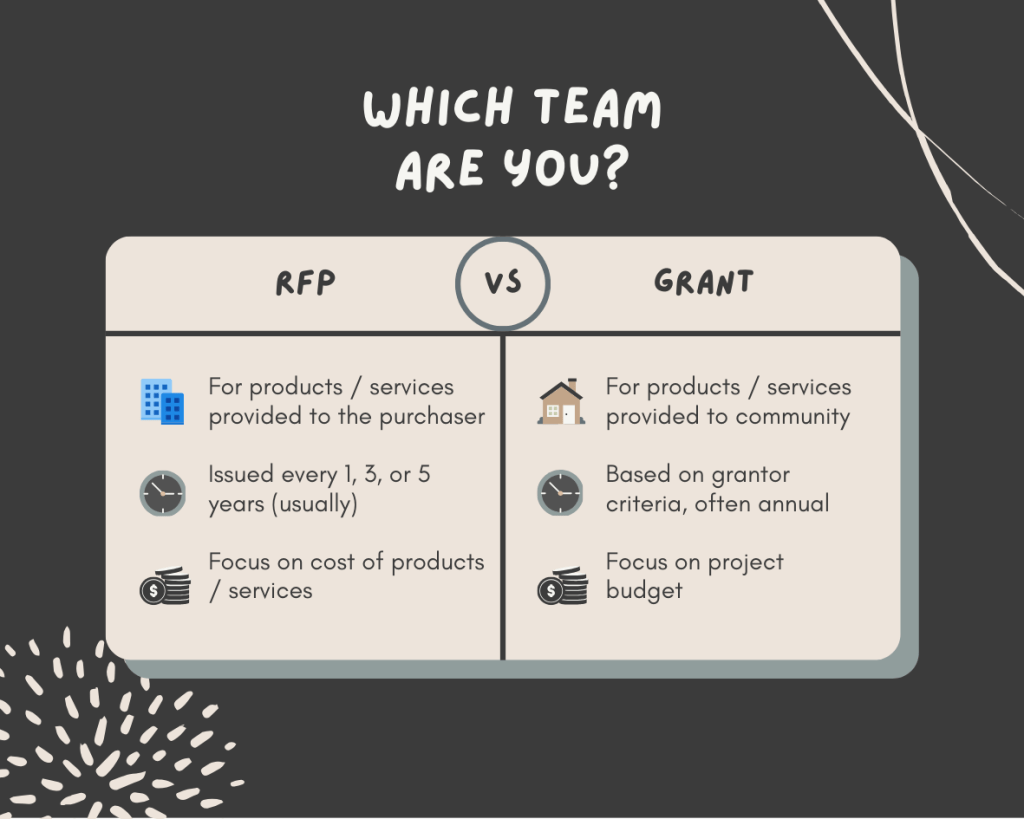
I’m often asked, “what is the difference between a grant and an RFP?”. (For more information on RFPs, see my blog post on Corporate Buying, Dec 2024).
To make things a bit easier, I am going to start with how they are the same. They both usually include a list of questions that must be submitted in a specific format at a specific time so that someone can decide who gets the money. Almost every RFP or grant includes questions about the organization, the product / service / program, and some reference to money or cost (either the cost of the proposed product or service, or the budget of the program / project / product for which you need the funds).
What makes RFPs and grants so different from each other? They key difference is their purpose:
RFPs sell a product or service to another company. Grants are a method of disseminating funds to other organizations, without benefit to the grantor.
Many of the strategies used to respond to grants are the same as RFPs, including knowledge of the client / grantor, the use of storytelling to relate to your audience, and great boilerplate content as a starting point to make writing easier. But understanding where and how RFPs and grants are different will ensure you use the correct strategy and resources to help ensure success.
RFPs and Grants – Key Differences
| RFPs | Grants | |
| Key Purpose: | To sell a product or service to another company. Typically results in a binding contract between 2 or more organizations. | To disseminate funds to organizations without benefit to the grantor. While there may be reporting requirements to the grantor, there are not generally any contractual arrangements beyond those agreed to upon acceptance of the funds (e.g. must be used for certain programs). |
| Services: | The vendor provides services exclusively to the Purchaser. | The organization provides services to the Community. |
| Timeframes: | Based on the length of the contract (often 1, 3 or 5 years). RFPs are released with short timelines to respond (depending on the product/service requested, etc.). | Generally applied for issued annually. Application dates are usually posted on the grantor website or emailed out with lots of notice with the application. |
| Decision Criteria: | Generally, highly objective with criteria around price, experience, product/service capabilities, security, and more. It is not recommended to rely on the reputation of your company as that doesn’t speak to the requirements of the client. | Many grants have a much more subjective set of criteria that is not published. There is often leeway for the reputation of the applying organization to be considered. |
| Format: | Usually includes a strict set of response criteria, and lots of detailed questions to ensure the product/service meets the specified requirements. Organizations like banks, healthcare and the Public Sector have different and more rigorous requirements than less regulated industries like retail and travel/hospitality. | Generally, not as many questions as an RFP and the focus is on what the applying organization does and what services they will provide with the funds granted. Questions are often limited to specific character word counts to ensure concise responses. |
| Rules of engagement: | The vendor company usually spends great effort building a relationship with the potential client but are usually not allowed to converse with them about the RFP once issued. Strict deadlines are observed. | Generally don’t limit communication if there is existing contacts between the Organization and the grantor. However, applying organizations typically don’t get any updates on the status of the application once submitted. |
| Show me the money: | Detailed vendor pricing is included based on the proposed product/service and is used as part of the evaluation. Pricing usually can’t be changed once proposed unless new information is provided that would change the scope or requirements. Assumptions submitted with the proposal can help limit risk. | A request is made for a set amount of money, usually within a guideline such as “up to $15,000 available”. Details on how the organization will use the money are part of the grant request. The grantor may decide to grant some or none of the available funds, but that does not preclude the organization from applying again the next period. |
 Reid Write Consulting
Leave a comment